
Key Takeaways:
- Use the official IATA vacancy and its Cornerstone application.
- Graduate and undergraduate internships have different study and eligibility rules.
- The public application includes a required CV upload and a required typed motivation answer.
- Saving a draft is separate from submitting. Review the form and retain the final record.
1. Choose the vacancy and recruitment route
Start with IATA vacancies, open the original notice and follow Apply now. IATA’s careers website links to iata.csod.com, its Cornerstone recruitment portal. Save the title, requisition number, location and vacancy text before drafting.1
Check whether you are applying for employment, an internship or an external assignment. IATA has separate routes for instructors, consulting experts and certification auditors. Its external consulting and auditing opportunities can be project-based; they should not be treated as ordinary staff appointments.7 The IATA organization profile explains its airline-industry work and helps you connect your experience to its mandate.
2. Check qualifications and local eligibility
Read the required education, experience, languages and work authorization in your own notice. Separate minimum requirements from advantages: the Banking Management internship, for example, asks for a recent relevant degree and English, while describing banking experience as an asset and ERP experience as beneficial.4
Graduate internships: IATA’s general programme requires at least a bachelor’s degree, graduation within the previous 12 months and excellent English. Assignments are full-time and normally last five to eleven months.
Undergraduate internships: Applicants must be enrolled in a local university’s undergraduate programme and have excellent English; opportunities can be full-time or part-time. Both programmes provide a monthly allowance, with amounts varying by location.3
Local restrictions still matter. The Singapore Banking Management example accepts citizens and permanent residents, plus foreign students already in Singapore who are authorized to undertake an internship through their university programme. It requires a full-time, six-month commitment. That exception is specific to the notice, not a promise of sponsorship for every applicant.4
If a screening question does not clearly cover your permitted situation, ask recruitment for clarification before selecting an answer. Do not describe a student internship authorization as unrestricted employment authorization.
3. Open the application and prepare your profile
The portal provides Sign in and Create Profile. The public registration screen asks for first and last names, email and confirmation, phone, password and confirmation, and a language choice. Follow its current password rules and read the Terms of Service before creating the profile.6
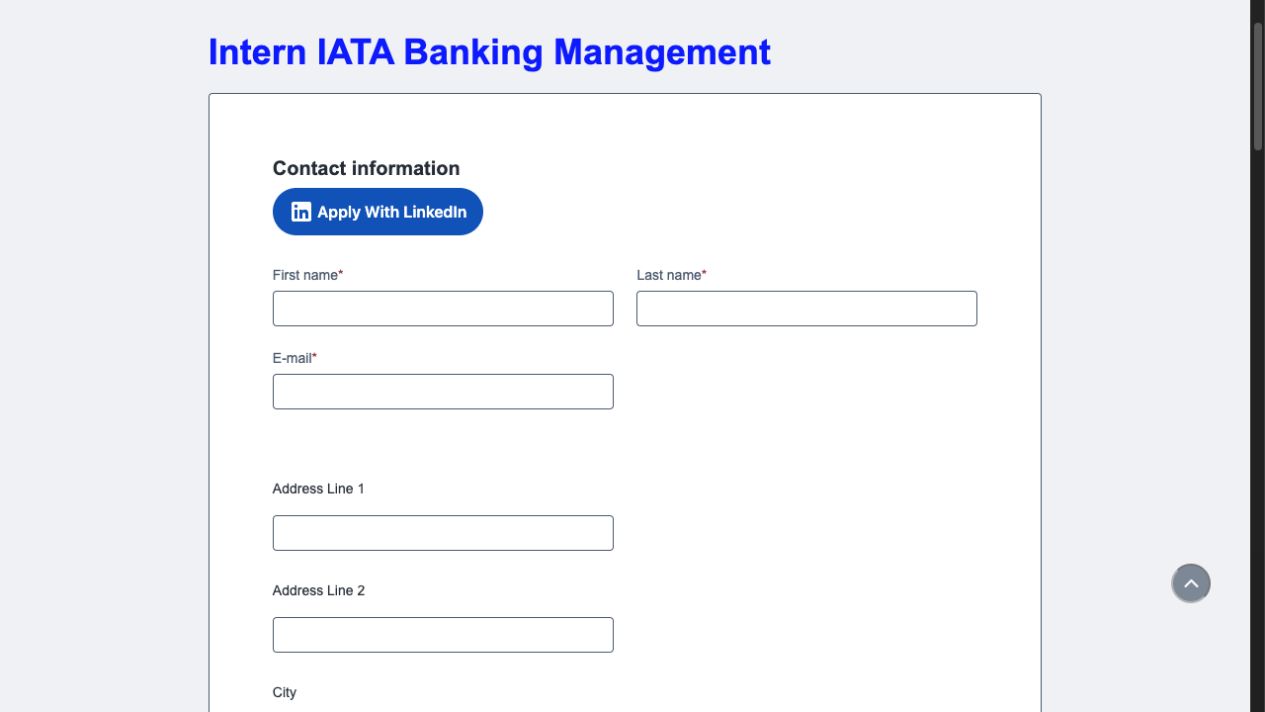
The Banking Management vacancy’s Apply now button also opens a blank application publicly. Its contact section includes first name, last name, email and phone marked required, plus address lines, city and country. Use an email you will keep access to and check the phone’s country code.5
Keep employment dates, degree dates and your relevant experience ready in your CV. The public example relies on a CV upload rather than displaying separate employment-history and education-entry sections. Follow any additional fields in your own vacancy; an account profile alone does not submit an application.
4. Upload the CV and write the motivation answer
The example form has a required Upload résumé/CV control and a separate Additional attachment upload. Check the accepted format and size in the live upload dialogue. Make the file readable and clearly named, and verify that the CV reflects the criteria for this role.5 The CV builder can help organize your experience before you export it.
IATA’s recruitment guidance asks for a CV and cover letter and stresses explaining your interest in the particular role.2 In the inspected form, motivation is also a required text answer asking why you want to work for IATA and why you chose this role. An attached letter does not remove the need to answer it.5
Draft a concise answer connecting the assignment to two or three relevant pieces of evidence. For a banking internship, that might be a finance project, accurate handling of records or analysis using Excel. Explain your contribution and result. Use the additional attachment for a cover letter when appropriate, while following any vacancy-specific document instruction.
5. Complete the screening questions honestly
The example asks how you found the role, whether you previously worked for IATA as an employee or external professional, and when you could start. It also asks about spoken and written English and Singapore work authorization. A salary field requests gross annual base salary and currency but explicitly says it does not apply to internships.5
Keep answers consistent with your CV and actual circumstances. State realistic availability after notice periods or study commitments. For a salaried role, distinguish annual base salary from monthly pay, bonuses and benefits. Do not enter an invented salary expectation into a field that excludes your internship category.
You can use Save application to continue later if you need more time. Return to the same vacancy and check that your draft is available; saving is not submission.5
6. Review, submit and track the application
Before choosing Submit, check the contact details, CV, attachments, motivation and eligibility answers. Read the privacy statement and the required agreement. The form separately offers consideration for other positions and making your information searchable; review that choice rather than treating it as the same as applying for this vacancy.5
Use any closing date and time stated in your notice and allow time for technical problems. A posting date is not an application deadline. Keep the final materials and any confirmation, and confirm the vacancy appears in your application record.
IATA’s form says you can track progress on your profile page and that recruitment will also keep you informed. Do not assume that a later CV or profile update changes an already-submitted application. If you discover a material mistake, contact recruitment before withdrawing or attempting a replacement.5 The careers page lists [email protected] for help. Include the requisition number and a concise description of the problem.1
7. Prepare for interviews and checks
IATA describes CV review followed by interviews for shortlisted candidates. Depending on the role, these may be online or in person and include case studies, technical questions and behavioural questions. Prepare examples of your own decisions, collaboration and results, and learn how the team’s work serves the airline industry.
Reference checks and other background checks can form part of the offer process. IATA does not give a fixed response period on its recruitment page; it encourages asking the hiring manager about the timeline. Follow the actual invitation and document requests rather than interpreting silence as a particular selection outcome.2