
Aid cuts should be assessed through the services people lose, alongside the budgets and jobs removed. A smaller programme may remain open while reaching fewer people or operating less often. Reporting those differences is essential if donors and organisations want to know what a saving actually costs.
A financial total cannot describe the whole effect
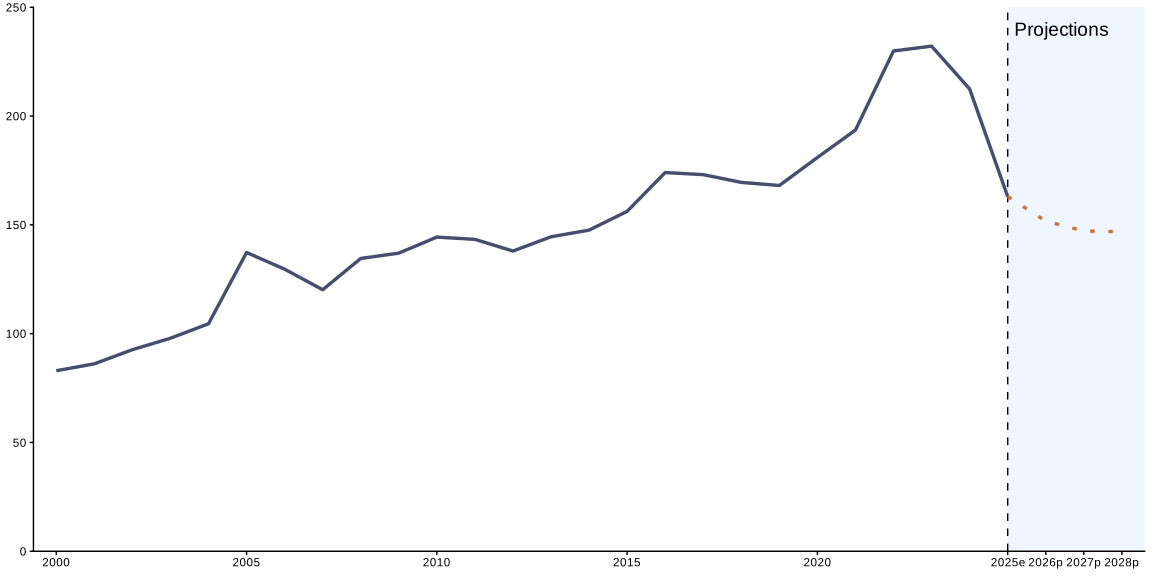
The OECD's June 2026 outlook projected a further 6.9 per cent fall in net official development assistance from its Development Assistance Committee members during 2026. It followed a reported 23.3 per cent decline in 2025. The projection is an estimate, while the earlier figures were preliminary; both are expressed at constant prices.1
Those numbers establish the scale of contraction in government aid. They do not tell a student how many jobs a particular organisation will advertise, or show which service in a particular country will disappear.
For either question, the next step is to follow the funding into the operation. Which activities were financed? What can the remaining budget sustain? What will people who relied on the service have to do instead? A headline about a global total cannot supply those answers.
An open service can still become harder to reach
UNAIDS' 2026 special report describes damage to community-led HIV services following funding withdrawals. These organisations support prevention, treatment and access to care, including for people who encounter stigma elsewhere. The report identifies their dependence on external financing and exposure to cuts.2
The implication is important for how recovery is reported. Keeping medicines available at a facility does not by itself demonstrate that everyone who needs them can reach care or obtain support to continue treatment.
If community outreach or support disappears, a programme may retain its most visible service while losing a route people used to access it. Assessments of continuity should record the lost route into care, even when the facility itself remains open.
Reopening does not always mean restoring access
UNICEF's December 2025 humanitarian-action report gives a specific example from the Rohingya camps in Cox's Bazar. Under funding constraints, secondary classes were prioritised. Some other classes operated only one day a week, while kindergarten and Grade 1 remained closed at the point described in the report.3
The example is dated, not a statement about which classes are open today. It demonstrates why a claim that education has resumed needs detail: which children, which grades and how many days of teaching?
Reopening selected classes may be the best option under severe constraints. Recognising the achievement and describing the remaining gap are compatible. Without both, a partial restoration can be mistaken for recovery of the whole service.
Efficiency needs a test of what continues working
WHO's November 2025 financing guidance recommends measures including better procurement, lower overheads and integration of externally funded services. It also reports health-worker losses and disruption to training.4 Saving resources is a legitimate objective, but the result has to be assessed against delivery.
An organisation should be able to explain which functions can be combined and which must remain available. Procurement, supervision and information systems may sit away from a classroom or clinic while still making its operation possible.
A proposed reorganisation should identify who will perform each necessary function, with what equipment and resources. Combining departments may reduce costs, but an organisational chart cannot show whether supplies will arrive, staff will receive supervision or records will remain usable.
Report what remains after the saving
Financial and staffing reports would be more useful alongside a concise account of service changes. The following questions should accompany claims about continuity or recovery.
- Availability: Which services remain, and how often do they operate?
- Reach: Who can still use them, and who has lost access?
- Capacity: Which people, supplies and systems are needed to maintain delivery?
- Recovery: What would be required to restore an interrupted service, and what has actually been restored?
Why the distinction matters to people entering the sector
For a student considering development work, funding pressure is more than a forecast about vacancies. It changes what teams need to do and what they may have the resources to teach. A role description should explain those responsibilities honestly.
The question of junior recruitment under UN80 raises a related concern about retaining experience and developing new staff. Both debates need evidence about the capacity that remains after a saving: the work a team can do, the people it can reach and the gaps it cannot yet close.