
Key Takeaways:
- Use ITU Careers and complete the candidate profile as well as the vacancy’s questions.
- A CV alone does not provide the full education, employment and skills record.
- The cover letter is optional but recommended; diplomas and passport copies may be requested later.
- Internships, national posts and sponsored JPO posts have distinct eligibility rules.
- Submit by the notice’s closing time and check the acknowledgment and Jobs Applied record.
1. Read the notice and identify the category
Start with ITU vacancies and open the original notice on jobs.itu.int. Record the vacancy number, contract, grade, duty station and closing time. Follow its Apply now link to the candidate system.
Professional and higher posts are recruited internationally. National Professional Officer posts are locally recruited, require nationality of the country of service and have a national context. General Service positions support operational, administrative and technical work and are filled by local residents or nationals. Check the exact vacancy’s eligibility rather than assuming every ITU position offers international recruitment.3
The ITU organization profile helps explain its radiocommunication, standardization and digital-development work. Read which sector and department is recruiting: an ICT policy, engineering or conference-coordination position can call for very different evidence.
2. Check the precise qualification and experience route
Match the essential criteria to your degree, employment record and languages. In the P-4 Study Groups Advisor example, ITU asks for an advanced relevant degree, seven years of progressively responsible experience and at least three years at international level. It allows a related doctorate to substitute for three years of experience.
The same notice’s first-degree-plus-ten-years alternative applies to internal candidates for promotion or rotation. An external applicant should not treat it as a general degree waiver. Its language requirements also distinguish an advanced first official language, an intermediate second language and a desirable third.7
Sponsored routes can be narrower. The Netherlands JPO Planning and Coordination notice is exclusively for Dutch nationals aged 32 or below at the end of the application year. It sets degree-based experience routes and limits previous UN-system work to one year, including the categories it lists. Check the current notice and sponsoring programme before applying; those restrictions are not the standard conditions for all ITU posts.8
3. Create the correct candidate account
Select Sign in, then Create an account if you are new. ITU’s public sign-in runs on career55.sapsf.eu. Registration asks for email and confirmation, password and confirmation, first and last names, and country or region of residence. Review the job-notification choice, password rules and data privacy statement before creating the account.4
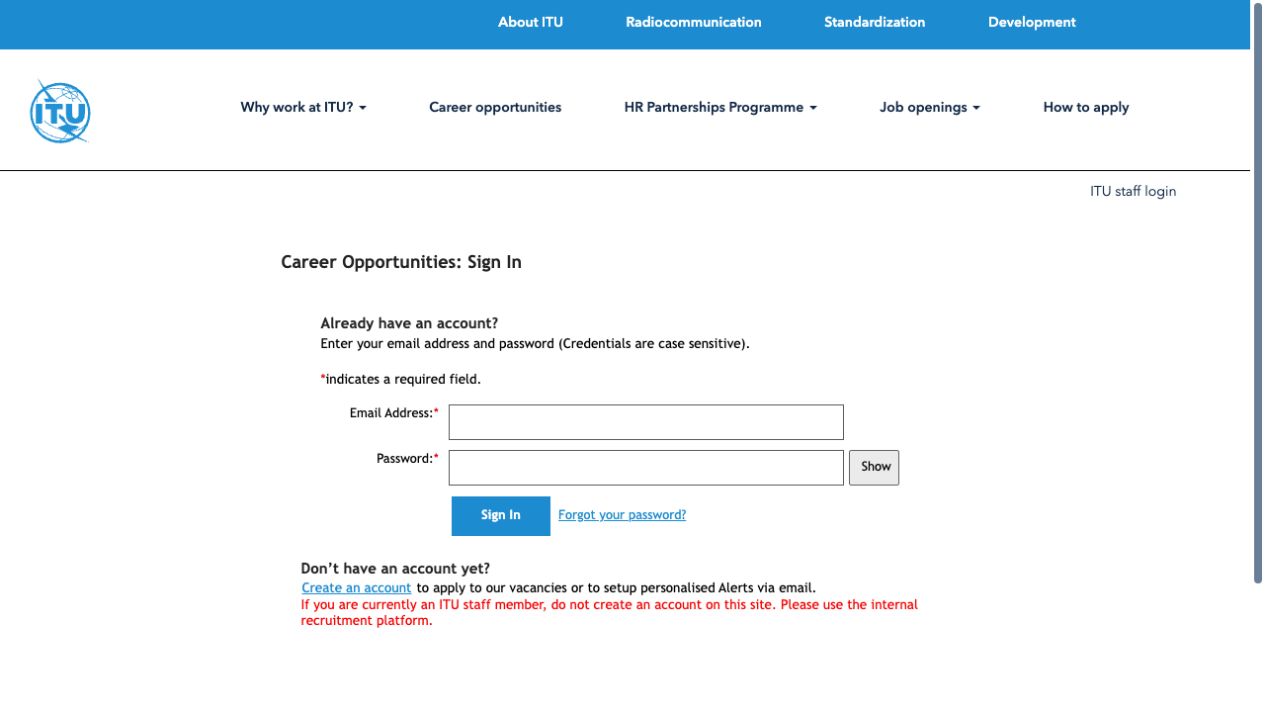
Current ITU staff use the internal Employee Profile. ITU’s FAQ directs consultants, interns and loaned staff to the external careers site.2 Keep access to the email used for your application and use password recovery for an existing account.
4. Complete the candidate profile and history
ITU’s candidate FAQ describes a profile covering personal information, address, languages, relatives in ITU or the UN common system, education, employment history, training and certifications, expertise, computer skills, publications and references. Prepare this record before applying.2
Enter accurate dates and qualifications. For work experience, describe the scope of your assignment, your own responsibilities and the results you achieved. Make concurrent jobs and part-time work clear. In a technical application, name relevant systems, standards or methods and explain how you used them rather than supplying an unsupported list of keywords.
You can use the general profile for several vacancies and customize each application. ITU says the latest submitted application updates that general profile. Review it again whenever applying to another opening so that the reusable record remains accurate.1
For short-term, consultant or internship opportunities, complete Contract Information clearly. ITU says a profile can sometimes be considered for specific needs, while ordinary selection requires applying to an advertised vacancy.2
5. Add relevant documents and answer the vacancy questions
ITU’s application walkthrough describes the cover letter as optional but highly recommended. Prepare a short explanation of your interest and the experience most relevant to this assignment. Diplomas, additional education and training documents, and a passport copy are not generally required to submit the profile or application, but may be requested later.1
Follow any additional instructions in your own notice and check its live attachment controls. A relevant CV is useful to prepare alongside the structured history; internships specifically require one. Do not replace the online profile with a CV or attach identity documents merely to make the application look more complete.
After reviewing the profile, answer the Job-Specific Information section and review its acknowledgments. ITU’s walkthrough explicitly separates these answers from the general profile.1 Draft against each actual prompt, using a relevant example and a measurable result where available. Keep dates, experience totals and language levels consistent throughout.
6. Check internship eligibility and costs separately
ITU’s current internship programme requires applicants to be under 30, with possible exceptions for PhD candidates; enrolled in an undergraduate, graduate or postgraduate programme, or recently graduated within six months of the internship; and citizens of an ITU Member State. Applicants must be able to provide a CV and university enrolment or graduation certificate.5
Read the assignment requirements too. The WSIS Forum Programme and Agenda notice measures recent graduation against the internship’s start. It asks for a relevant university degree and excellent English for research, drafting and editing, even though it requires no prior experience. General programme eligibility alone does not establish that you meet the particular role’s education requirement.6
The WSIS example is an unpaid, full-time, on-site Geneva internship. Medical insurance, travel, accommodation and living expenses fall to the intern or sponsoring institution.6 Budget for these before applying. The Switzerland application guide explains the immigration questions to raise for a Geneva assignment.
Check dates for consistency. This WSIS 2027 notice lists a November 2026 application deadline but gives placement dates in 2026. Ask ITU to confirm the intended placement dates before making availability or travel commitments; do not silently assume a corrected year.6
7. Review and submit before the closing time
Review the complete profile, attachments, answers and declarations before submission. The Study Groups Advisor notice uses midnight Geneva time on its stated closing date. Convert using the date and location so that summer-time changes are accounted for.7
ITU does not accept late applications. Its walkthrough says successful submission displays a confirmation message and sends an acknowledgment email. Check Jobs Applied for the vacancy and retain the final materials and confirmation.1
ITU permits withdrawal through the candidate account. That does not establish that you can replace a submitted application after closing. Do not assume a general-profile edit changes the already-submitted answers; ask recruitment about a material correction before withdrawing.2
8. Follow the record and prepare for assessment
Check Jobs Applied and your email. ITU’s FAQ says selection may take weeks or months and that all applicants receive a formal notification when a competition closes. It does not promise an individual interview or a response by a particular date.2
Current notices allow tests or assessments and a competency-based interview, including remote evaluation. Final-stage candidates undergo reference checks. Prepare examples against the advertised technical and functional competencies, explaining the situation, your action and the outcome. ITU charges no recruitment fee.7
For technical application problems, contact [email protected] with the vacancy details and any error screenshot. Remove unrelated personal information from the image.2