
Key Takeaways:
- CERN uses SmartRecruiters. Apply through the official vacancy, not by emailing a CV.
- Origin, Quest, staff jobs and student programmes have different eligibility rules.
- Check nationality restrictions and any temporary recruitment ceilings before drafting.
- Prepare the documents for your own programme and review everything before submitting.
1. Find the right CERN opening
Start with current CERN vacancies and follow the official application link. CERN identifies SmartRecruiters as its applicant tracking system and accepts complete applications through its careers website. Sending an application by email, post or social media does not replace that submission.1
Read the programme name and job reference alongside the title. CERN recruits technicians, engineers, computing specialists and administrative professionals as well as physicists. The CERN organization profile gives context, but the vacancy determines the actual duties, qualification, experience and language requirements.
A spontaneous application is a separate route. The Technical Origin notice says it may be used for unpublished projects or additional needs when advertised projects do not match your profile. It is neither mandatory nor a guarantee of an interview; apply directly to a suitable advertised project when one exists.8
2. Match the programme to your qualifications
Origin for university graduates: Your highest qualification must be a bachelor’s or master’s degree, with no more than two years of professional experience since graduation by the application deadline. PhD holders are excluded, and you must not previously have held a CERN fellow or graduate contract. Calculate experience against the notice’s cutoff rather than treating “recent graduate” as a description of your age.2
Origin without a university degree: The Technical Field spontaneous notice requires a general secondary education diploma as the highest qualification, no more than two years of post-graduation professional experience and no previous CERN fellow or graduate contract. Bachelor’s, master’s and PhD holders are explicitly ineligible for that call. A higher qualification does not make you eligible for every early-career route.8
Quest and research fellowships: CERN’s experienced-graduate guidance describes Quest as a route for master’s graduates with two to six years of post-graduation professional experience, or PhD graduates with up to three years. Research fellowships are a distinct category. Follow the individual opening for the field, experience calculation and other conditions; do not apply Origin’s limits to every graduate job.7
Staff jobs: Assess the qualifications, relevant experience and technical and behavioural competencies in the particular notice. A studentship or graduate programme is not a prerequisite you should assume for an experienced staff vacancy.
3. Check nationality and student status carefully
CERN’s university Origin page requires nationality of a Member or Associate Member State. It also publishes temporary restrictions when associate-member recruitment ceilings have been reached. These restrictions can change and are programme-specific: residence or a university place in an eligible country does not substitute for the nationality condition. Check both the current programme page and vacancy. If their lists differ, ask CERN before relying on the less restrictive version.2
Technical students: The current programme requires at least 18 months, or three semesters, of studies in the relevant field at selection and full-time enrolment throughout the placement. PhD students and holders are excluded. It also requires Member or Associate Member State nationality, subject to the published ceilings, and good English or French.3
Doctoral students: You must have started or be about to start a university doctoral programme. Your university must accept that the CERN research contributes to your thesis. The programme separately specifies nationality and language conditions. Discuss this academic arrangement with your university before presenting a placement as part of your doctorate.4
Summer students: CERN’s general summer programme is for bachelor’s or master’s students in physics, engineering, computer science or mathematics who have completed six semesters by the summer’s start. It requires full-time enrolment at least until the start, good English, no previous participation in the programme and no more than three months of earlier CERN work under another status.5
Openlab: This is a separate computing-focused summer programme. Its published FAQ welcomes all nationalities, requires a strong computing profile and sets its own study, enrolment and previous-CERN conditions. The 2026 FAQ allows students graduating during that European summer, but excludes a graduate who is not enrolled during the summer and will only start a master’s in September. Check the new call for your year rather than carrying forward an old deadline or exception.6
4. Prepare the correct documents
Prepare a concise CV showing relevant education, work and projects. CERN recommends English or French and ideally no more than two A4 pages. A short motivation message can explain your fit even where it is optional. Use the CV builder if useful, then check that the final file makes your own contribution and technical skills clear.1
Document requirements differ. University Origin asks for a diploma or a certificate of achievement if the paper diploma is not yet available.2 The current Technical Studentship page describes an academic reference letter and transcript as optional additions to the CV and application.3
Where a letter or transcript is requested, allow time to obtain it. Keep files clearly named and readable, and check whether the form expects individual attachments. A CV upload cannot supply a missing qualification document automatically.
5. Complete the SmartRecruiters application
Select I’m interested on the official vacancy. The public Technical Origin application offers CV import or Apply With Indeed to autocomplete the application, with manual entry also available. You can begin the public form manually without first signing into Indeed or creating a separate CERN account. The Sign in link in CERN’s general website toolbar is not the vacancy’s application button.
Its first page contains name, email and email confirmation, city, phone, experience, education, profile links, a resume upload and Message to the Hiring Team. Experience, education and resume are marked required on that example. Optional social-profile fields are not a reason to create new social accounts.9
Under Experience, select Add for job title, company, office location, description and start/end dates, with an I currently work here option. Under Education, add institution, major, degree, school location, description and dates, with an I currently attend option. Save each entry and review imported information against these fields.9
Message to the Hiring Team is a typed text box, separate from the required resume upload. Use it for your motivation for this opening. Its presence does not establish that every programme also needs an uploaded cover letter: provide additional files only as the notice and later application instructions request.9
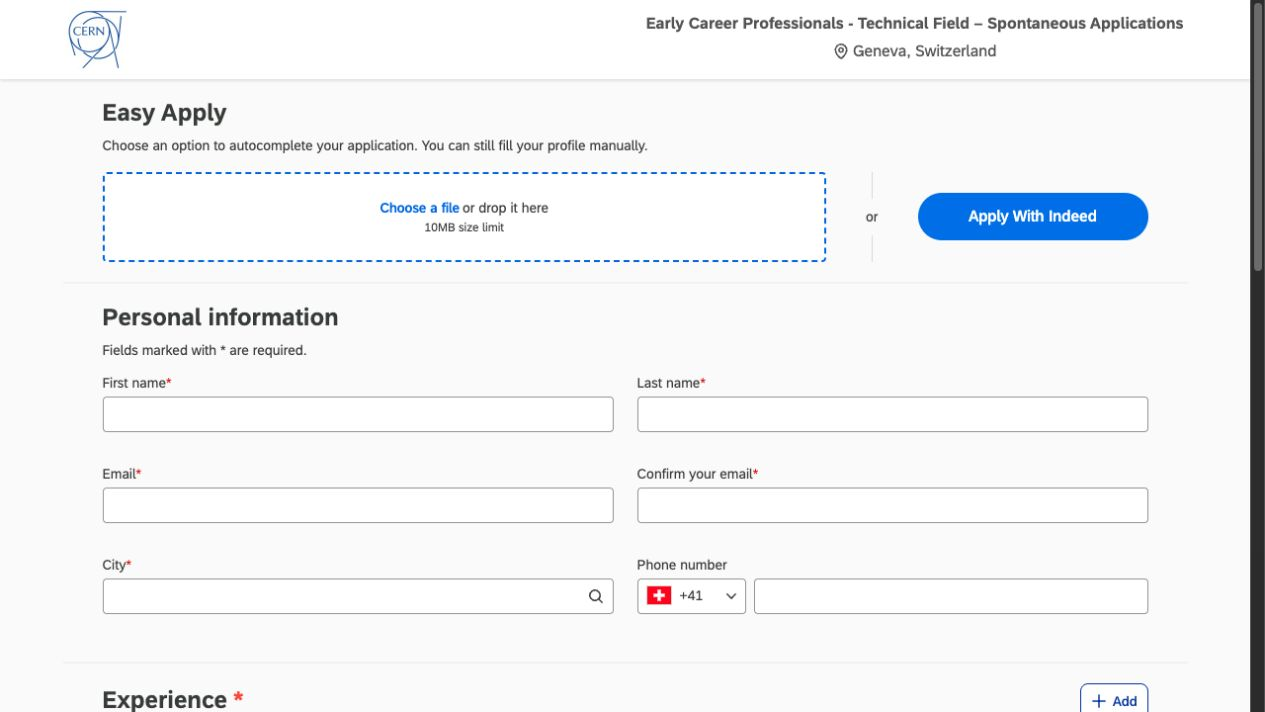
The example displays a 10 MB upload limit. Check the limit in your own live form, then review any information extracted from your CV against the structured education and experience entries. Use Next to continue through the vacancy’s questions; an initial upload is not the completed application.9
Answer screening questions literally and consistently with your qualification dates, nationality and experience. For technical answers, describe a relevant project, what you personally built or investigated, the methods or tools used and the outcome. Explain a relevant university project as a university project rather than relabelling it professional employment.
You may apply to more than one CERN job; CERN says applications are assessed independently. Tailor the motivation and project examples to each opening while keeping the underlying facts consistent.1
6. Review before the deadline and keep the record
Save the complete vacancy and job reference. Compare each required criterion with your answers, check contact details and attachment readability, then complete the final submission. Keep the version you sent and any confirmation or application record provided.
Use the closing time in the actual notice. For example, the Technical Origin spontaneous call specifies 31 December 2026 at 23:59 CET. That is not a universal CERN closing date. Convert the stated time zone using the closing date, and allow time for upload problems.8
CERN’s published candidate FAQ says submitted applications cannot be edited and describes withdrawing and reapplying to make changes. Before withdrawing, confirm that the vacancy remains open and that a replacement is possible. Do not withdraw after a deadline expecting that you can restore the application, and do not assume a profile change updates material already submitted.10
7. Track progress and prepare for the actual assessment
Use the candidate tracking link on CERN’s application-tips page to monitor or withdraw an application. Retain access to the email address used for submission and check spam as well as the candidate area.1 CERN describes recruiter and hiring-manager review, possible requests for clarification and communication of the outcome. A broad processing status is not an interview invitation or offer.11
Depending on the role, selection may include asynchronous video interviews, technical and behavioural assessments or a panel interview. Prepare from the notice and follow the invitation’s format. CERN’s general hiring page directs candidates to programme-specific processes, so do not assume that every studentship follows the same interview sequence as a staff job.12
For unresolved eligibility or technical questions, CERN’s contact page directs candidates to its resources and Candidate Questions Form.13 If you receive an offer, confirm the employment or association category and onboarding arrangements with CERN. The Switzerland guide helps you identify relocation questions before committing to travel or housing.